BURIED TOGETHER
Husband Lord Byron, Partner Mary Millicent Montgomery
Queer Places:
11 St George's Terrace, London NW1 8XH, UK
Kensal Green Cemetery, Harrow Road, Royal Borough of Kensington and Chelsea, Greater London W10 4RA England
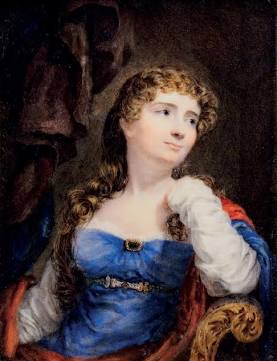 Anne Isabella Milbanke, 11th Baroness Wentworth and Baroness Byron (May 17, 1792 – May 16, 1860)—often known as Annabella—was a highly educated English aristocrat,
mathematician, social reformer, and educational pioneer. Though widely remembered in mainstream history as the long-suffering wife of the Romantic poet
Lord Byron, modern biographical and queer history perspectives highlight her complex emotional life, her intellectual
autonomy, and her lifelong close bond with Mary Millicent Montgomery.
Anne Isabella Milbanke, 11th Baroness Wentworth and Baroness Byron (May 17, 1792 – May 16, 1860)—often known as Annabella—was a highly educated English aristocrat,
mathematician, social reformer, and educational pioneer. Though widely remembered in mainstream history as the long-suffering wife of the Romantic poet
Lord Byron, modern biographical and queer history perspectives highlight her complex emotional life, her intellectual
autonomy, and her lifelong close bond with Mary Millicent Montgomery.
Born in Eleanor, County Durham, Annabella was the only child of Sir Ralph Milbanke, 6th Baronet, and the Hon. Judith Noel. Unusually for young women of the Regency era,
her parents provided her with a rigorous home education overseen by a Cambridge university tutor.
She excelled in classical literature, philosophy, science, and especially mathematics and astronomy. Lord Byron would later famously nicknaming her his "Princess of
Parallelograms" due to her analytical, structured mind.
From an early age, she held deep moral convictions and a passion for philanthropy, focusing on educational equity, prison reform, and the abolition of slavery.
Annabella first met the sensationally famous poet George Gordon, Lord Byron, in March 1812. Byron proposed in 1812, but she initially declined. After an extensive
correspondence, she accepted his second proposal in September 1814, and they married on January 2, 1815.
The marriage was notoriously volatile and short-lived:
Byron was deeply in debt, emotionally unstable, and engaging in erratic behavior fueled by heavy drinking. Rumors and mounting evidence of his incestuous relationship
with his half-sister, Augusta Leigh, created severe tension.
On December 10, 1815, Annabella gave birth to their only legitimate child, Ada Augusta Byron (later Ada Lovelace, the pioneer
of computer science, whose mathematical talents were heavily nurtured by her mother).
In January 1816, fearing for her safety and her child's wellbeing, Annabella left Byron and returned to her parents' estate. A formal legal separation was executed in
April 1816, after which Byron left England forever.
Beyond her marriage to Byron, Annabella's emotional and romantic life centered significantly around passionate, intense female friendships—a common context for romantic
friendships in the 18th and 19th centuries that modern historians evaluate through a queer lens.
Annabella's most enduring and emotionally vital relationship was with Mary Millicent Montgomery (often called "Mary Anne" or "Montgomery").
The two women met in their youth before Annabella's marriage to Byron. Their relationship was characterized by intense emotional intimacy, rich correspondence, and deep
mutual devotion.
During the breakdown of Annabella's marriage and the chaotic public scandal of 1816, Mary Millicent Montgomery served as a primary source of emotional stability,
counsel, and sanctuary.
Their extensive surviving letters feature expressions of intense love, jealousy, and possessiveness typical of "romantic friendships" of the period, which often
operated as primary life partnerships for women outside heteronormative marital structures.
Though their relationship endured periods of friction—often tied to Annabella's exacting moral standards and her hyper-fixation on social reform—Montgomery remained a
constant, central figure in Annabella's life until Lady Byron's death in 1860. Montgomery survived her by eight years, dying in March 1868.
Following her separation from Byron, Lady Byron devoted her life, wealth, and influence to social causes:
She founded the first industrial school in Britain, Ealing Grove School (1833), which combined traditional academic instruction with practical agricultural and
vocational skills for working-class boys.
She was an active supporter of the anti-slavery movement, attending the 1840 World Anti-Slavery Convention in London as one of the prominent female advocates.
She encouraged her daughter Ada's mathematical education, laying the groundwork for Ada's historical collaboration with Charles Babbage.
Lady Byron died of breast cancer on May 16, 1860, one day before her 68th birthday, and was buried in Kensal Green Cemetery, London.
References:
- https://en.wikipedia.org/wiki/Lady_Byron
- https://archives.lib.ku.edu/repositories/3/resources/5588
- https://www.oxforddnb.com/display/10.1093/ref:odnb/9780198614128.001.0001/odnb-9780198614128-e-45789
Support this project
This website is a passion project researched, developed, and funded entirely by me. If you find the content valuable and would like to help support the ongoing research and hosting costs, any contribution is deeply appreciated.
Thank you for keeping this independent resource alive!
My books on Amazon: Elisa Rolle's books
BACK TO HOME PAGE